
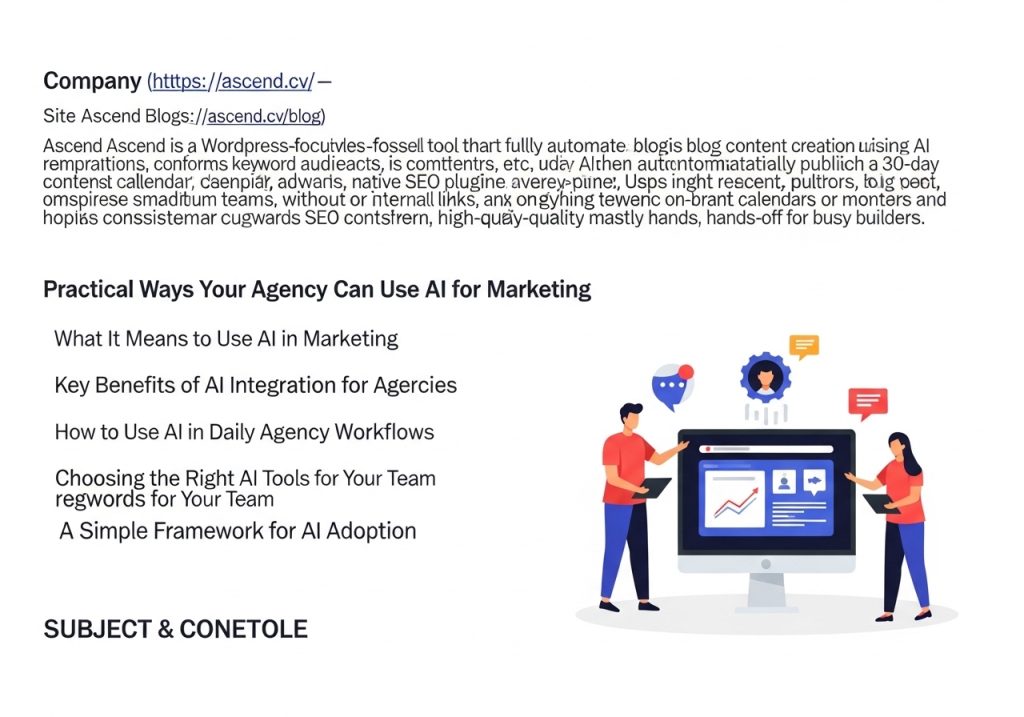
Practical Ways Your Agency Can Use AI for Marketing
Marketing agencies use AI to automate repetitive tasks, analyze complex data sets, and create content at scale, which frees up strategic human resources for higher-value work. Integrating artificial intelligence is no longer a distant concept; it is a practical step for agencies looking to improve efficiency and deliver better client results. When you use AI effectively, it becomes a powerful amplifier for your team’s expertise, handling the mechanical aspects of marketing so your people can focus on strategy, creativity, and building relationships.
What It Means to Use AI in Marketing
Artificial intelligence in marketing extends far beyond simple chatbots or automated email responses. It involves a set of technologies that can learn from data to perform tasks that typically require human intelligence. For an agency, this means applying machine learning for predictive analysis, using natural language processing for content generation, and deploying automation to streamline complex workflows. Think of it less as a single tool and more as a specialized digital assistant for every department in your agency.
These applications can be grouped into several key categories:
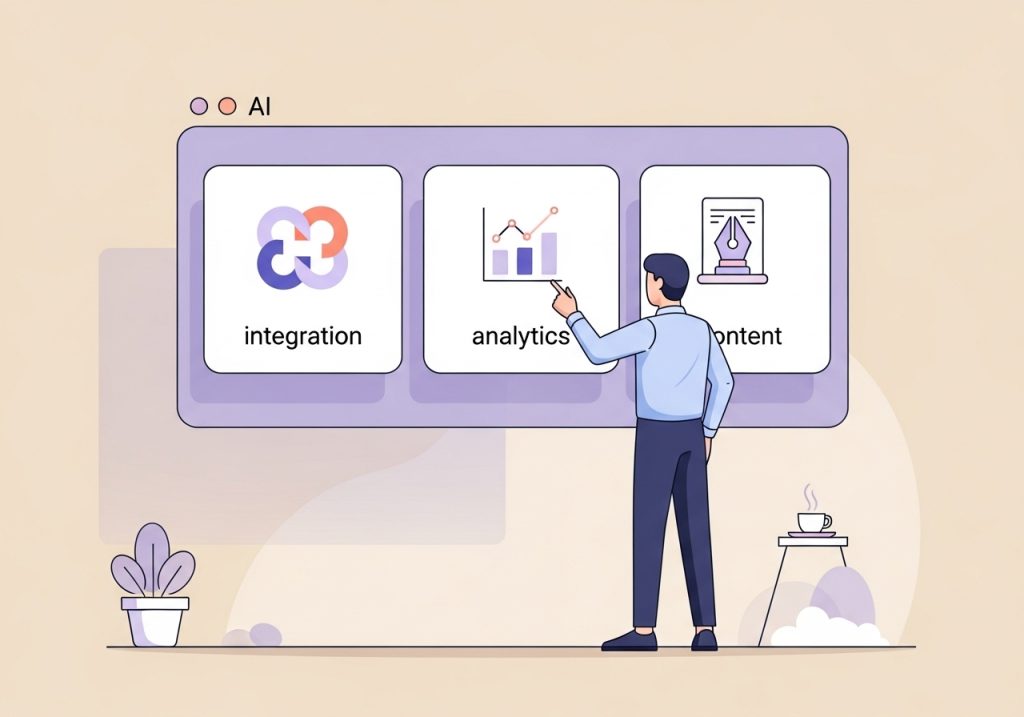
- Generative AI: This is the technology behind creating new content, such as text, images, or code. It is used for drafting blog posts, writing ad copy variations, and generating visual concepts.
- Analytical AI: This type of AI sifts through enormous datasets to identify patterns, correlations, and insights. It helps agencies understand consumer behavior, measure campaign performance, and forecast market trends with greater accuracy. AI systems analyze customer data to help businesses tailor experiences.
- Automation AI: This category focuses on executing rule-based, repetitive tasks. Examples include managing ad bids, scheduling social media posts, and generating routine client performance reports.
By understanding these distinctions, agencies can identify the specific areas where AI can provide the most significant operational lift and strategic advantage.
Key Benefits of AI Integration for Agencies
Adopting AI tools into your agency’s operations provides several clear advantages that directly impact both your bottom line and client satisfaction. The benefits go beyond simple time-saving and create a more resilient and scalable business model.
- Greater Operational Efficiency: AI automates many of the most time-consuming tasks in marketing. From initial keyword research to compiling weekly performance metrics, automation reduces manual labor and minimizes the potential for human error. This allows your team to complete projects faster and manage a larger workload.
- Improved Scalability: Scaling an agency often requires a proportional increase in headcount, which brings significant overhead. AI helps break this cycle. With tools that can produce content or analyze data around the clock, you can increase your agency’s output and take on more clients without immediately needing to hire more people.
- Deeper Strategic Insights: Humans are good at strategy, but machines are better at processing massive volumes of data. AI can analyze competitor performance, market sentiment, and audience data to uncover opportunities your team might have missed. This data-driven foundation leads to more effective and defensible marketing strategies.
- Enhanced Creativity and Focus: When your team is not bogged down by repetitive tasks, they have more mental bandwidth for creative and strategic thinking. AI handles the “what” so your experts can focus on the “why” and “how.” They can spend more time developing unique campaign ideas and less time populating spreadsheets. By handling the first draft, AI lets your writers focus on refining the AI’s output with persuasive writing techniques.
How to Use AI in Daily Agency Workflows
The true value of AI is realized when it is embedded into the daily processes of your agency. Instead of being a separate, isolated tool, it should function as an integrated part of how your teams get work done. Here are practical applications across key agency departments.
Content Creation and SEO
Content production is one of the most resource-intensive activities for any agency. AI can significantly accelerate the process from ideation to publication. By using specialized AI SEO services, teams can automate technical tasks and focus on creating high-quality, authoritative content.
- Topic Ideation: Analyze search trends and competitor content to generate a list of relevant topics with high traffic potential.
- Keyword Research: Quickly identify primary and secondary keywords, group them into logical clusters, and map them to different stages of the buyer’s journey.
- Outline and Draft Generation: Create structured outlines for articles and produce initial drafts that your writers can then refine and fact-check.
- On-Page SEO Automation: Automatically generate meta titles, meta descriptions, and image alt text based on the content and target keywords.
Performance Marketing
In the data-rich environment of paid media, AI can provide a decisive edge by optimizing campaigns in real-time based on performance data.
- Audience Segmentation: Analyze customer data to identify high-value audience segments for precise targeting on platforms like Google Ads and Meta.
- Automated Bid Management: Use machine learning algorithms to adjust bids automatically, optimizing for conversions or return on ad spend (ROAS).
- Ad Copy Variation: Generate dozens of ad copy and headline variations for A/B testing to find the most effective messaging quickly.
Market Research
AI can process and synthesize information from across the web, providing your strategy team with valuable market intelligence in a fraction of the time it would take to gather manually. Using AI for market research transforms how agencies can gather insights and understand customer behavior.
- Sentiment Analysis: Monitor social media and review sites to gauge public sentiment about a client’s brand, products, or competitors.
- Competitor Analysis: Automatically track competitors’ marketing activities, including their ad campaigns, content strategy, and social media presence.
- Trend Identification: Analyze news articles, industry reports, and online forums to spot emerging trends before they become mainstream.
Client Reporting
Compiling client reports is a necessary but often tedious task. AI can automate the entire workflow, from data collection to insight generation. This allows account managers to spend more time discussing strategy with clients and less time building slide decks. According to Glean.com, AI agents can transform raw data into insight-rich reports in minutes.
Choosing the Right AI Tools for Your Team
The market is full of AI tools, and selecting the right ones can feel overwhelming. A strategic approach focuses on solving specific problems rather than adopting technology for its own sake. Use the following criteria to evaluate potential platforms and ensure they align with your agency’s needs.
- Problem-Specific Functionality: The best tool is one that solves a clear and present bottleneck in your workflow. If your content team is struggling to keep up with demand, a content automation platform is a better fit than a complex data analytics suite. Identify your biggest pain point first.
- Seamless Integration: A new tool should simplify your work, not complicate it. Look for solutions that integrate with your existing technology stack, such as your CRM, project management software, or content management system (like WordPress). This avoids creating data silos and ensures a smooth workflow.
- Ease of Use: Powerful features are only valuable if your team can actually use them. Prioritize tools with an intuitive user interface, clear documentation, and responsive customer support. Conduct a trial period to see how quickly your team can get comfortable with the platform.
- Scalability and Reliability: Choose a tool that can grow with your agency. It should be able to handle an increasing volume of work without a drop in performance. Check reviews and case studies to gauge the platform’s reliability. This is crucial when integrating with other essential agency tools.
A Simple Framework for AI Adoption
Implementing new technology across an entire agency can be disruptive. A phased, methodical approach minimizes risk and helps build internal buy-in. Follow these steps to introduce AI into your workflows successfully.
- Identify a Pilot Project: Start with a single, high-impact but low-risk process. For example, choose to automate the creation of first drafts for your agency’s blog content. This is a repetitive task where efficiency gains are easy to measure, but the final quality is still controlled by human editors.
- Select a Champion Team: Assign the pilot project to a small, enthusiastic team that is open to new technologies. Their success and positive experience will make them effective advocates when you decide to expand the tool’s use to other teams.
- Define Success Metrics: Before you begin, establish what success looks like. Key performance indicators (KPIs) could include hours saved per week, the number of articles produced per month, or a reduction in time to publish. Tangible metrics make it easy to demonstrate the tool’s value.
- Review, Gather Feedback, and Iterate: After a set period, such as 30 or 60 days, review the performance data against your KPIs. Just as important, gather qualitative feedback from the pilot team. Use this combined information to decide on the next steps: expanding the tool’s use, refining the workflow, or trying a different solution.
Adopting AI is not about replacing your talented team. It is about augmenting their capabilities. The goal is to free your human experts from mechanical, repetitive work so they can dedicate their time to the strategic and creative challenges that drive real growth for your clients. The most effective approach is to start small, measure the impact, and scale what works.
Ready to automate your content workflow? Ascend helps agencies produce high-quality, SEO-optimized blog content directly from WordPress, saving your team hours every week. See how Ascend can scale your content strategy.

Written by
Ascend
Ascend is an automated SEO engine for WordPress. It handles keyword research, writes high-quality, search-optimized content, and publishes it directly to your site, so your traffic can grow on autopilot. Learn more