
SEO vs PPC: A Strategic Guide to Search Marketing Investment
Marketing agencies and SaaS builders often face a difficult capital allocation question: should resources go toward immediate traffic through ads or long-term organic growth? The “SEO vs PPC” debate is rarely about which channel works; both generate revenue. The real question involves the mechanics of your investment. You must decide whether to rent your audience or build an asset that you own.
Search Engine Optimization (SEO) and Pay-Per-Click (PPC) represent two fundamentally different financial instruments. One offers speed and control, while the other offers compounding equity and sustainability. Understanding the specific leverage points of each allows you to build a strategy that targets short-term revenue targets without sacrificing long-term profitability.
Renting Traffic vs Building Equity
The most accurate way to frame these two channels is through the lens of asset ownership. PPC is synonymous with renting. You pay a platform—usually Google or Bing—for a premium position on the search results page. As long as you pay the rent, you occupy the space. You get visibility, traffic, and leads. However, the moment you stop paying, the traffic stops immediately. You possess no equity in the position you occupied.
SEO is the digital equivalent of buying land and building a house. The upfront costs are significant. You spend time and money on technical architecture, content creation, and link acquisition without seeing an immediate return. Yet, once you secure a ranking, that traffic belongs to you. It flows to your site 24/7 without a direct cost for every click. Over time, this asset appreciates. A high-ranking page can drive business for years with only minor maintenance.
For agencies, this distinction is critical when advising clients. A client needing next week’s sales figures needs a rental agreement. A client looking to exit or reduce acquisition costs over five years needs to audit their web presence and build a permanent asset.
SEO vs PPC: Analyzing Cost Efficiency and ROI
Financial leaders often prefer PPC because the math is simple: spend $1, get $2 back. The Customer Acquisition Cost (CAC) is stable and predictable. However, PPC costs rarely go down. Inflation and increased competition usually drive Cost Per Click (CPC) up over time. Your margins in year five will likely be lower than in year one unless your product price increases significantly.
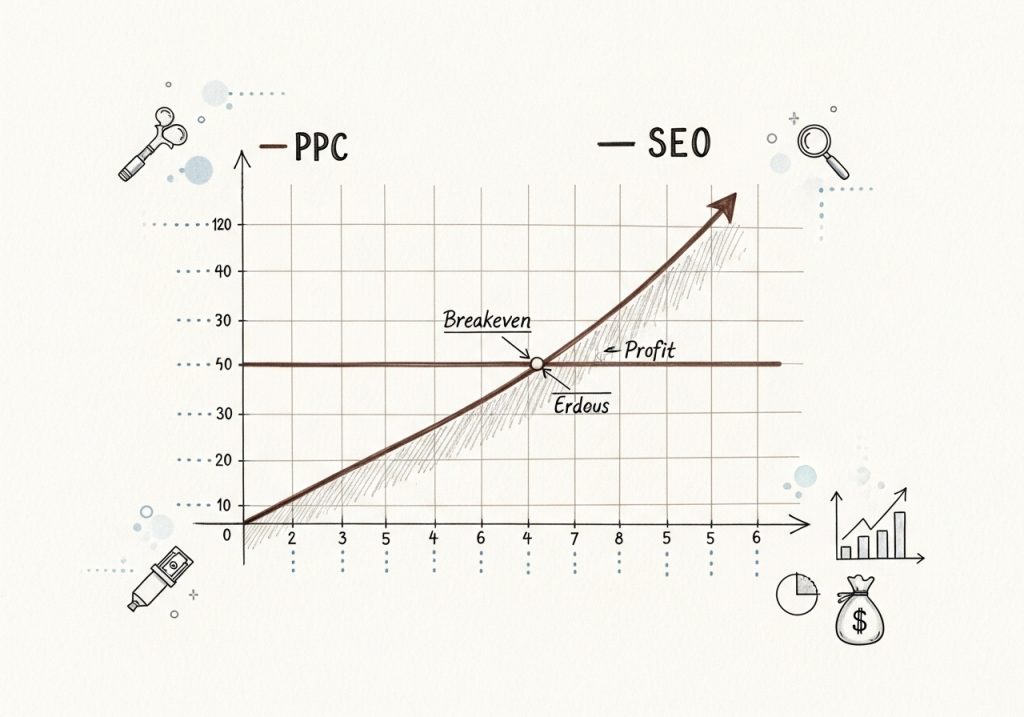
SEO offers a different financial curve. In the beginning, your CAC is astronomical. You might spend thousands of dollars on content and strategy with zero visitors to show for it. This is the “valley of death” where many companies quit. But as traffic begins to compound, the cost per visitor plummets toward zero. The content you paid for once continues to generate value indefinitely.
Consider a SaaS company targeting the keyword “best project management software.”
- PPC Scenario: They pay $15 per click. To get 1,000 visitors, they pay $15,000. To get another 1,000 next month, they pay another $15,000.
- SEO Scenario: They spend $2,000 creating a world-class guide. In month one, it gets 10 visitors (CAC: $200). By month twelve, it ranks #1 and brings in 2,000 visitors a month. The cost remains fixed at the initial $2,000, but the return grows exponentially.
The Speed Factor: Immediate Visibility or Compound Growth
Time is the main variable that separates these strategies. PPC is immediate. You can launch a campaign in the morning and see your first lead by the afternoon. This speed is valuable for testing new offers, validating product-market fit, or capitalizing on seasonal trends.
SEO requires patience. A new domain might take six to twelve months to see significant traction. Even established sites wait weeks for new pages to index and climb the rankings. If your runway is short, relying solely on organic search is dangerous.
However, the slowness of SEO is also its defensive moat. Competitors cannot easily displace you once you establish authority. To overtake a strong organic position, a competitor must invest the same amount of time and effort you did. In PPC, a competitor with a bigger budget can displace you instantly.
The Integrated Approach: Using Paid Data to Fuel Organic Strategy
Smart marketing teams do not view this as a binary choice. They use PPC to subsidize the learning curve of SEO. One of the biggest risks in SEO is spending months ranking for a keyword that generates traffic but no revenue. PPC solves this data gap.
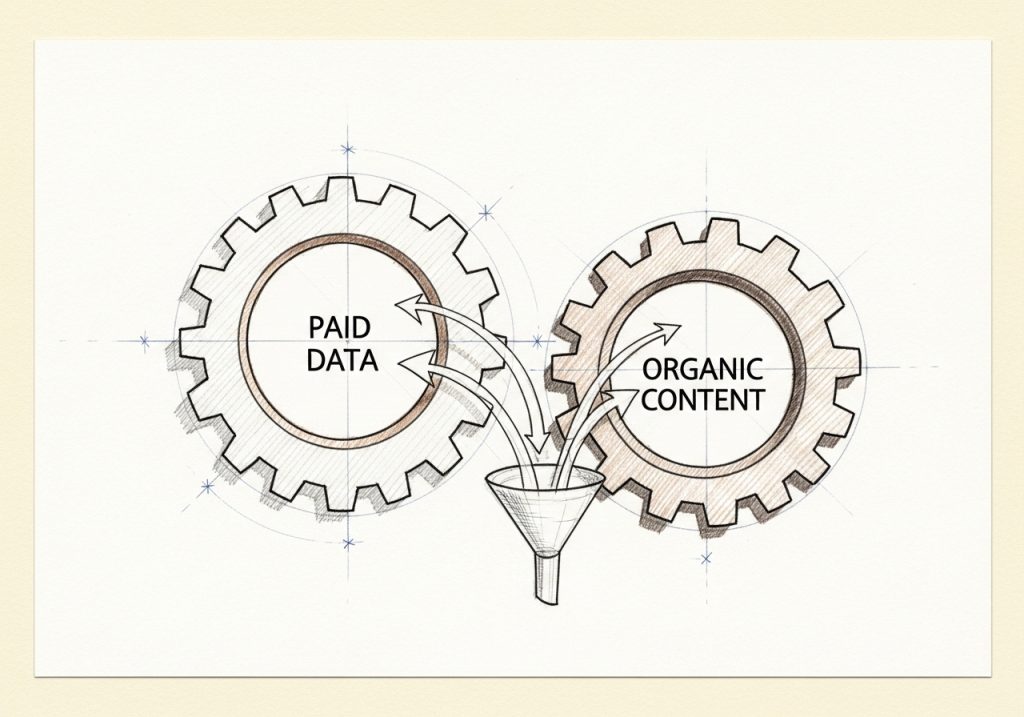
By running ads on your target keywords, you can verify conversion rates before investing in long-form content production. If a keyword converts well via paid ads, it is a safe bet for your organic calendar. If it drives clicks but no sign-ups, you saved your content team hours of work.
Furthermore, paid search data provides a clear roadmap for marketing competitive analysis. You can see exactly which headlines earn clicks and which value propositions resonate with your audience. You can then apply these insights to your meta titles and H1 tags to improve your organic click-through rates.
Solving the Volume Problem with Automation
The primary barrier to SEO success is volume. To compete with established giants, you need to produce high-quality content consistently. Historically, this meant hiring expensive editorial teams or managing unreliable freelancers. This labor cost often narrowed the ROI gap between SEO and PPC.
AI automation has shifted this dynamic. Tools that automate the research, writing, and publishing process allow smaller teams to compete on volume without inflating their overhead. By reducing the time required to produce a post from days to minutes, the “upfront cost” of SEO drops significantly. This accelerates the timeline to ROI and makes the organic channel accessible even for lean startups.
When you remove the manual labor bottleneck, SEO becomes a pure strategy game. You are free to focus on architecture and conversion rather than struggling to fill a content calendar.
Strategic Allocation for Growth
The decision between SEO and PPC ultimately depends on your timeline and capital structure. If you need immediate feedback or have a temporary promotion, pay for the placement. If you are building a brand that intends to dominate a category for the next decade, invest in your own infrastructure.
The most resilient brands do both. They rent traffic to keep the lights on and gather data while they relentlessly build an organic machine in the background. Eventually, the organic traffic surpasses the paid traffic, allowing you to reduce ad spend and increase profitability. That is the moment a business transitions from surviving to scaling. To get there, you must start demonstrating real ROI to stakeholders and proving that the slow road is often the most profitable one.
Stop trading your time for traffic. Ascend helps you build a permanent organic asset by automating your entire blog content workflow—from keyword research to publishing. Start building your organic engine today at Ascend Blog.

Written by
Ascend
Ascend is an automated SEO engine for WordPress. It handles keyword research, writes high-quality, search-optimized content, and publishes it directly to your site, so your traffic can grow on autopilot. Learn more