
What Is Automated Content Marketing? A Practical Guide
Creating high-quality content consistently is a significant challenge for marketing agencies and SaaS companies. The process demands extensive resources, from keyword research and topic ideation to writing, editing, and publishing. As you scale, these demands multiply, making it difficult to maintain momentum without a large team. This is where automated content marketing offers a practical solution to a persistent operational bottleneck, allowing teams to produce valuable content efficiently while focusing human expertise on high-level strategy.
What Exactly Is Automated Content marketing?
Automated content marketing uses software and artificial intelligence to manage and execute the entire content lifecycle. It goes far beyond simple social media scheduling or email automation. A true automation platform handles tasks like competitor analysis, keyword research, content calendar creation, drafting articles, generating images, and publishing directly to your blog. The objective is to reduce manual intervention in the most repetitive and time-consuming stages of content production, freeing your team to focus on creativity and strategy.
Think of it like an assembly line for content. In a traditional process, a strategist might spend hours analyzing SERPs for a single topic, a writer spends a day drafting the article, and an editor refines it before it finally gets uploaded. An automated system can perform the initial analysis in minutes. It can then generate a comprehensive, data-informed first draft based on that research. This allows your team to shift its focus from production to higher-level tasks like promotion, community engagement, and performance analysis, where human insight provides the most value.
Key Benefits of an Automated Content Strategy
Integrating automation into your content workflow provides several distinct advantages, especially for organizations managing multiple brands or a high volume of content. These benefits translate directly into better marketing outcomes and a more efficient team.

- Improved Consistency: Maintaining a regular publishing schedule is critical for SEO and audience engagement. A steady stream of content signals to search engines that your site is an active authority on your topics. Automation ensures content is always ready to go, removing human error and delays from the equation. This consistency helps build topical authority and keeps your audience returning.
- Enhanced Scalability: For an agency, onboarding a new client often means a linear increase in content workload. Automation breaks this direct relationship, allowing you to scale content production without a proportional increase in headcount. You can manage more clients or expand into new content verticals with the same core team, increasing profitability and capacity.
- Greater Efficiency: Content creation involves many repetitive tasks. Automating keyword research, brief creation, and first drafts frees up your marketing professionals to concentrate on what they do best. Instead of spending their days on production, they can focus on refining brand voice, building backlinks, nurturing partnerships, and measuring performance. This also helps in redefining the role of the modern SEO copywriter, shifting them from pure production to strategic oversight.
- Data-Driven Approach: AI-powered tools make decisions based on vast amounts of data. They can identify content gaps in the market, predict topic performance, and structure articles for SEO effectiveness with a level of precision that is difficult to achieve with manual analysis alone. This data-first method increases the probability that each piece of content will perform well.
The Process Behind Automated Content Marketing
Modern content automation platforms follow a logical workflow to move from strategy to a published article. While specific features vary between tools, the core process generally includes a few key stages that transform a simple idea into a fully optimized blog post.
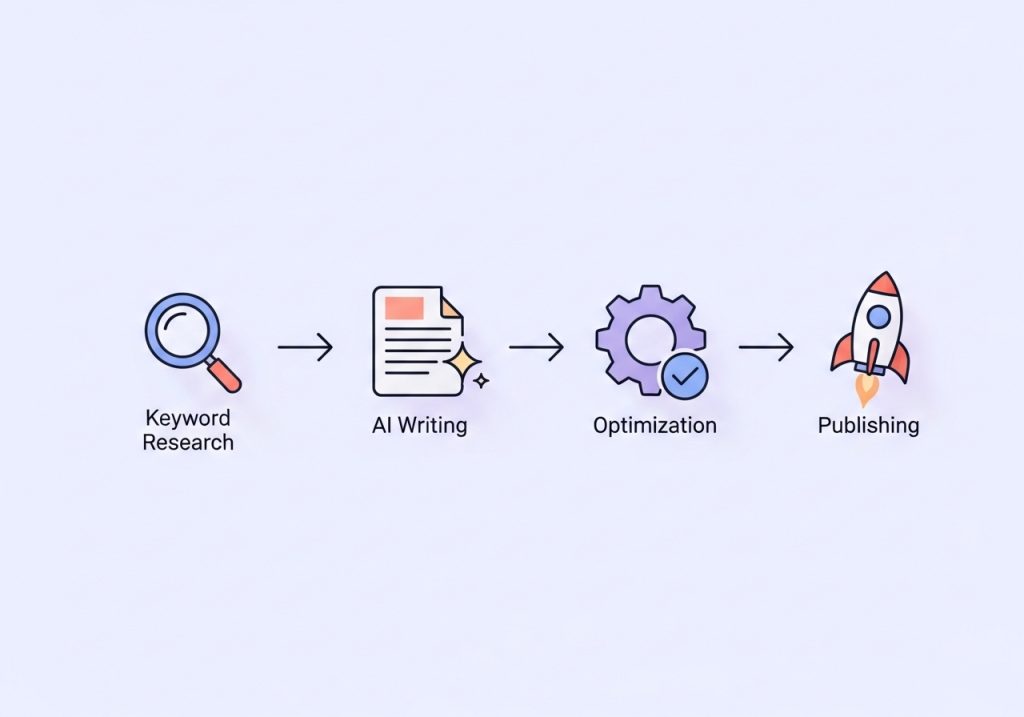
First, the system conducts research and planning. You provide initial inputs about your brand, target audience, and key competitors. The AI uses this foundation to perform deep keyword research and semantic analysis. It identifies valuable topics that align with your business goals and have a strong potential to rank. The output of this stage is often a complete content calendar filled with relevant post ideas for the upcoming month or quarter.
Next comes content generation and optimization. For each topic on the calendar, the AI drafts a complete blog post. Good systems do more than just write text. They incorporate on-brand imagery, add relevant internal links to your existing content, and integrate with SEO plugins like Yoast or Rank Math to ensure all on-page elements are correctly configured. This step is about effectively integrating AI copywriting into a marketing workflow, turning a raw draft into a publish-ready asset.
Finally, the platform handles scheduling and publishing. The completed and optimized articles are automatically added to your WordPress dashboard as drafts or scheduled for future publication according to the content calendar. This end-to-end process ensures a steady flow of high-quality content to your site with minimal daily oversight, transforming content marketing from a series of manual tasks into a predictable, automated system.
Choosing the Right Automation Platform
When evaluating tools for automated content marketing, it is important to look beyond just the AI writing capabilities. A truly effective platform offers a comprehensive solution that addresses the entire content lifecycle. Consider the following criteria to find a tool that fits your agency or SaaS business.
- WordPress Integration: A platform that operates directly within your WordPress admin dashboard is far more efficient than one that requires you to constantly switch between different applications. Native integration streamlines the entire workflow, from content creation to publication, and eliminates the friction of copying and pasting.
- Content Quality and Control: Assess the quality of the AI-generated content. Does it produce articles that are well-researched, coherent, and require only minor editing? Equally important, does the platform allow you to fine-tune the brand voice, style, and tone to match your company’s specific guidelines? The best tools offer a balance of automation and human control.
- End-to-End Functionality: The most valuable tools handle more than just writing. Look for platforms that manage the full process, including keyword research, content calendar creation, image inclusion, internal linking, and final publication. A system that automates the whole workflow provides significantly more value than one that only addresses a single step.
Implementing an automated content system is about augmenting your team, not replacing it. The goal is to give your strategists and marketers the tools they need to execute more effectively and at a greater scale. To begin, identify the most time-consuming parts of your current content workflow. Finding a platform that directly addresses those specific bottlenecks is the most practical first step toward building a more efficient and scalable content engine.
Ready to put your content on autopilot? Ascend fully automates your WordPress blog, from keyword research to publishing a new, high-quality article every day. Stop spending hours on content production and start scaling your organic traffic. Discover how Ascend works.

Written by
Ascend
Ascend is an automated SEO engine for WordPress. It handles keyword research, writes high-quality, search-optimized content, and publishes it directly to your site, so your traffic can grow on autopilot. Learn more