
What Is Customer Impact and How Can You Measure It?
Customer impact is the measurable, positive effect a product or service has on a customer’s ability to achieve their goals. It moves beyond simple satisfaction scores to quantify the tangible value a customer receives, such as increased revenue, saved time, or improved efficiency. For marketing agencies and SaaS companies, understanding and tracking this impact is essential for proving value, reducing churn, and building a sustainable business based on customer success.
Beyond Vanity Metrics: Defining Real Customer Impact
In digital marketing and software development, it is easy to get lost in vanity metrics. These are numbers like page views, social media followers, or feature clicks. While they can indicate activity, they often fail to tell the whole story about whether a customer is actually succeeding. True customer impact is about outcomes, not just outputs. It answers the question: “Is our customer better off because they use our product?”
Imagine you run a social media scheduling tool. A vanity metric would be the number of posts a customer schedules per month. An impact metric, however, would be the percentage increase in their audience engagement or the number of qualified leads generated from their social channels. The first metric shows usage; the second shows value. This distinction is critical because customers do not pay for usage, they pay for results.
To properly define customer impact, focus on these characteristics:
- Outcome-Focused: It tracks progress toward the customer’s end goal, not just their interaction with your platform.
- Quantifiable: It can be measured with specific numbers, whether it is dollars saved, hours reclaimed, or conversion rates boosted.
- Customer-Centric: The metrics are defined by what success means to the customer, not what it means to your company.
- Value-Driven: It directly reflects the core value proposition of your product or service.
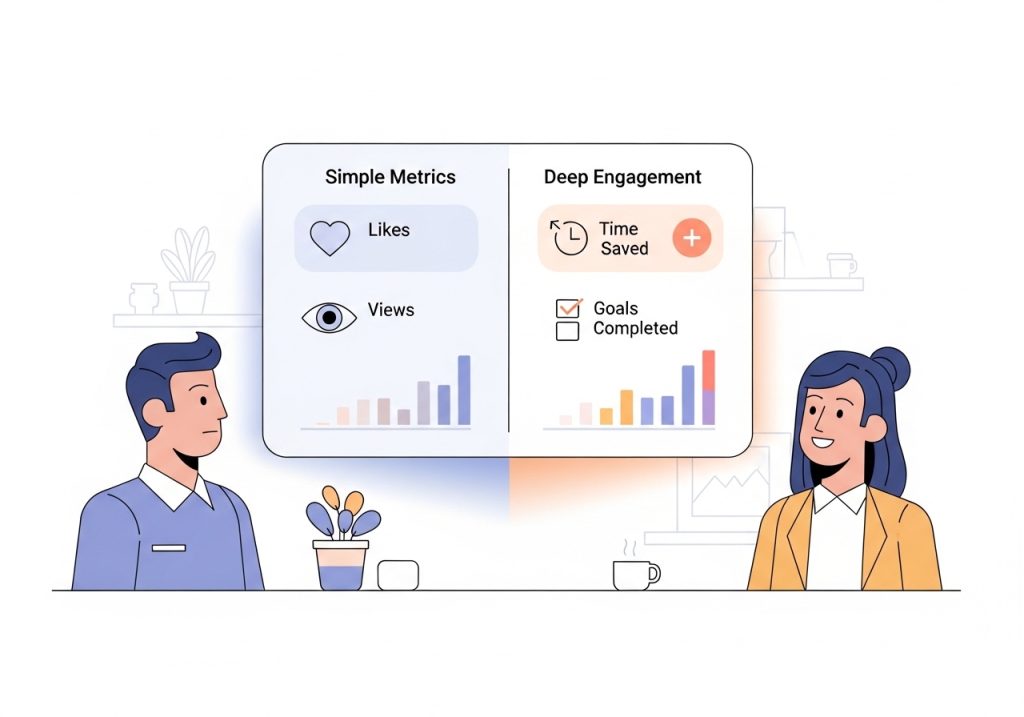
For an agency, the impact is not the number of reports delivered but the client’s growth in market share. For an AI productivity tool, it is not the number of documents generated but the reduction in time spent on administrative tasks. Shifting your focus to these deeper metrics is the first step toward building a truly customer-centric organization.
Why Measuring Customer Impact Is Non-Negotiable for Growth
Tracking customer impact is not just an academic exercise. It has direct and significant consequences for your company’s growth and stability. When you can prove that your product delivers real-world results, you create a powerful engine for retention and expansion. Customers who clearly see the value they receive are far less likely to churn.
In fact, research shows that customer experience is a major factor in loyalty. A report from Zendesk noted that 73% of consumers will switch to a competitor after multiple bad experiences. A lack of perceived impact is a core component of a bad experience. By measuring and communicating your positive impact, you proactively defend against churn.
Here are several key business benefits of prioritizing customer impact:
- Improved Customer Retention: When customers can draw a straight line from your product to their success, your service becomes indispensable. This locks in recurring revenue and increases customer lifetime value (LTV).
- Informed Product Development: Understanding which features drive the most significant impact helps you prioritize your product roadmap. Instead of building what customers ask for, you can build what they truly need to succeed.
- Stronger Marketing and Sales: Quantifiable impact metrics become powerful proof points for your marketing materials and sales conversations. Case studies built on real data are far more compelling than generic feature lists.
- Increased Word-of-Mouth Referrals: Customers who achieve their goals become your best advocates. Their success stories provide authentic social proof that attracts new, high-quality leads.
Ultimately, a business model built on customer impact is more resilient. It creates a partnership where your success is intrinsically linked to your customers’ success, leading to healthier, long-term growth.
A Framework for Quantifying Customer Impact
Measuring customer impact requires a systematic approach that combines both quantitative data and qualitative feedback. It is not about finding one perfect metric but about creating a comprehensive view of the value you deliver. Following a structured framework helps ensure your efforts are consistent and meaningful.
You can begin quantifying the effect your work has on clients by adopting a multi-step process. According to analysts at TTEC, the first step is to assemble an analytic data repository that consolidates customer interaction data from various sources. This creates a single source of truth for analysis.
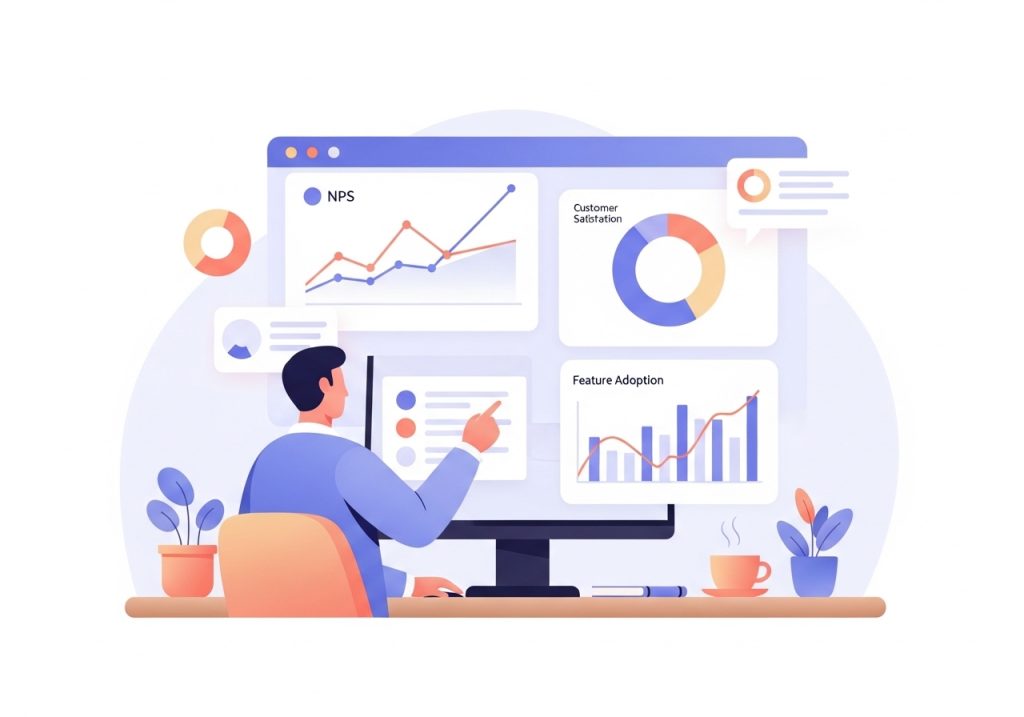
Here is a practical framework you can adapt for your business:
- Identify the Customer’s “Job to Be Done”: Start by understanding the fundamental problem your customer is trying to solve. What is the core goal they “hired” your product to achieve? For many businesses, a key job is mastering lead generation to fuel their sales pipeline.
- Define Key Performance Indicators (KPIs): Based on the job to be done, identify specific, measurable KPIs. If the job is to save time, the KPI could be “hours saved per week.” If the job is to increase sales, the KPI would be “percentage increase in monthly revenue.”
- Track Product and Usage Data: Use analytics tools to monitor how customers interact with your product. Look for patterns that correlate with success. For example, do customers who use a specific feature achieve their goals 50% faster? This is your product’s “magic moment.”
- Collect Business Outcome Data: Where possible, integrate with your customers’ systems to track business-level outcomes. A marketing automation tool could use a CRM integration to show exactly how much pipeline it helped generate. This provides undeniable proof of impact.
- Gather Qualitative Feedback: Numbers alone do not tell the full story. Use surveys like Net Promoter Score (NPS) and Customer Satisfaction (CSAT) to gauge sentiment. Conduct regular customer interviews to hear in their own words how your product is helping them. This context is invaluable.
How Strategic Content Directly Boosts Customer Impact
Content marketing is often seen as a tool for acquisition, designed to attract new visitors and convert them into leads. While it excels at that, its role extends far beyond the top of the funnel. Strategic content is a powerful lever for increasing customer impact and ensuring users get the maximum value from your product or service.
Think of your content as part of your product experience. A well-written guide or an insightful webinar can be just as valuable as a new software feature, especially when it helps a customer overcome a challenge or discover a more effective workflow. Understanding what a blog post is in this context is key; it is a vehicle for customer education and success.
Here’s how a thoughtful content strategy contributes directly to customer success:
- Accelerates Onboarding: Clear tutorials, getting-started guides, and video walkthroughs help new users achieve their first “win” quickly. This reduces time-to-value and builds momentum, making them less likely to abandon the product.
- Promotes Feature Adoption: Many users only engage with a fraction of a product’s capabilities. Content that highlights advanced features or unique use cases can help them unlock more value, deepening their reliance on your tool.
- Shares Best Practices: Your product is a tool, but your expertise is what makes it powerful. Content that teaches industry best practices positions you as a strategic partner and helps customers achieve better outcomes than they could on their own.
- Reinforces Value: Regular communication through newsletters, blog posts, and case studies reminds customers of the value you provide. It keeps your brand top-of-mind and reinforces their decision to choose you.
By investing in content that educates and empowers, you are investing directly in your customers’ success. This creates a positive feedback loop where successful customers become loyal advocates, fueling a new cycle of growth.
Focusing on customer impact forces a shift from a company-centric to a customer-centric worldview. It redefines success not by your own growth metrics but by the tangible, measurable value your customers achieve. This approach provides a clear path to building a more durable business by aligning your product development, marketing, and success teams around a single, unified goal. To get started, identify one key outcome your product delivers and find a simple way to measure it. That single metric can become the foundation for a strategy that drives retention, advocacy, and sustainable growth.
Creating content that drives customer impact requires time, research, and consistency. Ascend automates the entire process, from keyword research to daily publishing, right inside your WordPress dashboard. Stop spending hours on content and start delivering value that keeps your customers engaged. Discover how Ascend can help you scale your content strategy today.

Written by
Ascend
Ascend is an automated SEO engine for WordPress. It handles keyword research, writes high-quality, search-optimized content, and publishes it directly to your site, so your traffic can grow on autopilot. Learn more