
What Is Generative Engine Optimization (GEO)? The Next Evolution of Search
The landscape of digital marketing is undergoing its most significant transformation in decades. For over twenty years, the goal of search engine optimization (SEO) has been straightforward: rank as high as possible on a search engine results page (SERP) to drive traffic to your website. However, the rapid adoption of Artificial Intelligence (AI) and Large Language Models (LLMs) is rewriting the rules of discovery. As platforms like Google’s AI Overviews (formerly SGE), ChatGPT, and Perplexity AI become primary sources of information, businesses must adapt to a new paradigm.
This shift has given rise to a new discipline known as GEO. But what is generative engine optimization, and how does it differ from the traditional SEO strategies that have dominated the industry for so long? Understanding this concept is no longer optional for content strategists and business owners—it is essential for survival in an AI-first world.
What Is Generative Engine Optimization?
Generative Engine Optimization (GEO) is the strategic process of optimizing content to maximize visibility and citation within AI-generated answers. Unlike traditional SEO, which focuses on ranking links in a list, GEO focuses on becoming the source material that AI models use to construct their responses.
When a user asks a question to a Generative Engine (GE) like Google Gemini or ChatGPT, the AI does not simply retrieve a list of websites. Instead, it synthesizes information from multiple authoritative sources to generate a single, coherent answer. GEO is the art of structuring your content, authority, and data so that these engines recognize your brand as a trusted source, increasing the likelihood that your content is synthesized into the answer and cited with a link.
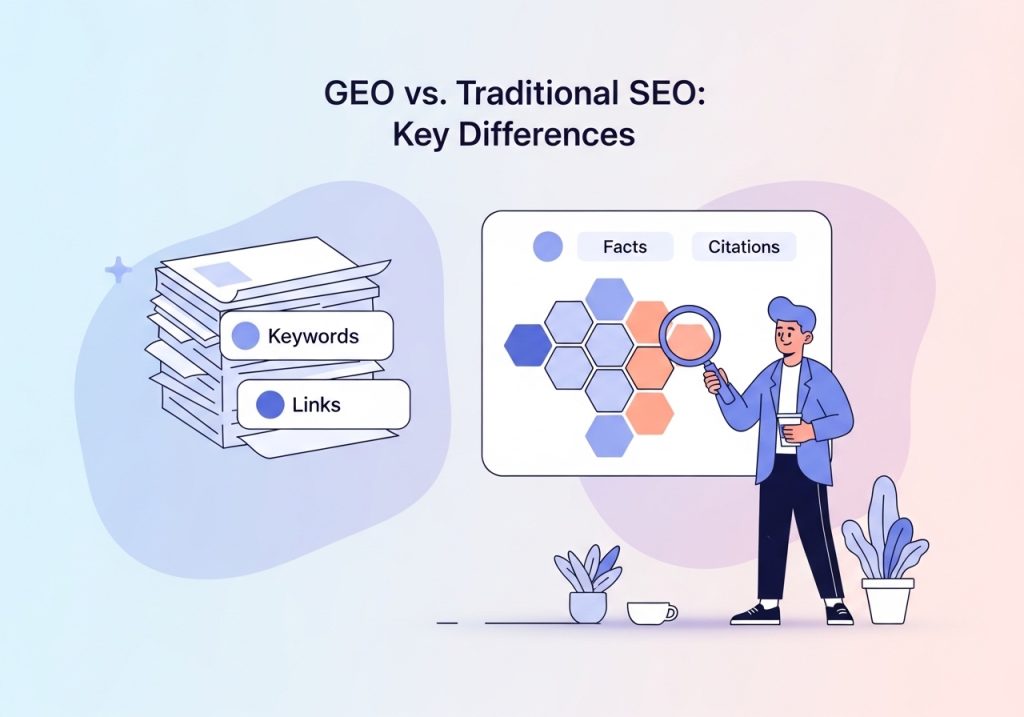
GEO vs. Traditional SEO: Key Differences
While GEO and SEO share the ultimate goal of increasing organic visibility, the mechanics of how they achieve this are fundamentally different. Traditional SEO is often technical and keyword-centric, focusing on metadata, backlink volume, and specific keyword density to appease an algorithm that sorts links.
GEO, conversely, requires a shift toward “fluency” and authority. Generative engines prioritize content that is easy for machines to parse, highly factual, and rich in unique insights. They are looking for direct answers to complex queries rather than just matching keywords.
The Shift from Keywords to Context
In traditional SEO, you might optimize a page for “best CRM software.” In GEO, the AI engine is attempting to answer, “Which CRM software is best for a small agency with a limited budget?” To win in this environment, your content must provide comprehensive context, comparative analysis, and clear, structured reasoning that the AI can extract and summarize.
Why GEO Matters for Modern Businesses
The introduction of AI Overviews in Google Search pushes traditional organic links further down the page—or removes the need for users to click them entirely. This phenomenon, often called the “zero-click” future, poses a threat to businesses relying solely on traditional traffic methods.
If your content is not optimized for generative engines, you risk becoming invisible. Being the “blue link” at the #1 spot matters less if the user gets their answer directly from the AI at the top of the page. However, this also presents a massive opportunity. Being cited in an AI overview acts as a powerful endorsement. It signals to the user that your brand is a primary authority on the topic, potentially leading to higher-quality, higher-intent traffic, even if the overall volume decreases.
Core Strategies for Generative Engine Optimization
Adapting to GEO does not mean abandoning your current SEO efforts. Instead, it involves layering new strategies on top of your existing foundation to make your content “machine-friendly.” Here are the core pillars of a successful GEO strategy.

1. Optimize for “Answer Engine” Formatting
Generative engines prefer content that is structured logically. Use the BLUF (Bottom Line Up Front) method. When tackling a specific heading, provide a direct, concise answer in the first paragraph before expanding on the details. This makes it easier for the AI to extract a “snippet” or summary from your page.
2. Cite Authorities and Statistics
AI models are designed to reduce hallucinations by grounding their answers in facts. Content that includes unique data, specific statistics, and citations from other authoritative sources is more likely to be trusted by the algorithm. Whenever you make a claim, back it up with data or an expert quote.
3. Use Structured Data and Schema
Technical SEO still plays a role here. Using Schema markup helps AI engines understand the entities on your page—identifying what is a “product,” a “review,” or a “person.” The clearer you make your data structure, the easier it is for the engine to ingest and repurpose your content.
4. Focus on Topic Authority
Generative engines rely heavily on semantic relationships. They want to know that your site is an authority on the broader topic, not just a single keyword. creating interconnected clusters of content that cover every angle of your niche is vital. This depth signals to the AI that your site is a comprehensive resource worth citing.
Leveraging Automation for High-Quality GEO Content
One of the biggest challenges in GEO is the need for depth and freshness. AI models crave up-to-date information and comprehensive coverage. For small to medium teams, producing the volume of high-quality, research-backed content required to establish topical authority can be overwhelming.
This is where automation becomes a strategic asset. Tools like Ascend allow builders to maintain a consistent publishing schedule without sacrificing quality. By automating the research and drafting phases, teams can ensure they are covering the necessary semantic ground to appeal to generative engines, ensuring their brand remains visible as search behavior evolves.
Conclusion
We are standing at the precipice of a new era in search. Understanding what is generative engine optimization is the first step toward future-proofing your digital presence. As search engines evolve into answer engines, the businesses that succeed will be those that optimize not just for clicks, but for comprehension, authority, and citation. By focusing on high-quality, structured, and fact-based content, you can position your brand as the trusted source that powers the AI answers of tomorrow.
Ready to future-proof your content strategy without the manual grind? Ascend Blog automates your SEO and GEO efforts, researching, writing, and publishing high-quality, on-brand content daily. Start growing your organic traffic on autopilot today.

Written by
Ascend
Ascend is an automated SEO engine for WordPress. It handles keyword research, writes high-quality, search-optimized content, and publishes it directly to your site, so your traffic can grow on autopilot. Learn more