
What Is Programmatic SEO? A Guide to Scaling Content
Programmatic SEO is a method of using automation to create a large number of unique, targeted web pages from a structured dataset and a consistent template. This approach allows businesses to efficiently capture traffic from thousands of long-tail search queries that would be impractical to target with manually written articles. Instead of writing one blog post at a time, you build a system that can generate an entire library of valuable content.
Defining Programmatic SEO
At its core, programmatic SEO is about scaling content creation through technology. Think of it like a mail merge for web pages. In a mail merge, you have a letter template and a list of contacts in a spreadsheet. The software automatically inserts each contact’s information into the template to produce personalized letters. Programmatic SEO works on the same principle, but the output is search-optimized landing pages.
The goal is to serve users who make very specific, “long-tail” searches. For example, a user is more likely to search for “best project management software for remote marketing agencies” than just “software.” A programmatic approach allows a SaaS review site to create thousands of pages targeting every combination of software type, industry, and team size. According to an analysis by Siege Media, this strategy uses automation to create pages at scale, effectively targeting thousands of such specific keywords.
This method is not about creating low-quality or spammy content. When done correctly, it produces pages that are genuinely useful because they directly answer a very specific user query. The value comes from the data itself and how it is presented in a clear, consistent format.
How Programmatic SEO Works: The Core Components
A successful programmatic SEO project depends on three fundamental components working together. Each part plays a critical role in transforming raw data into a large volume of user-friendly, optimized web pages.
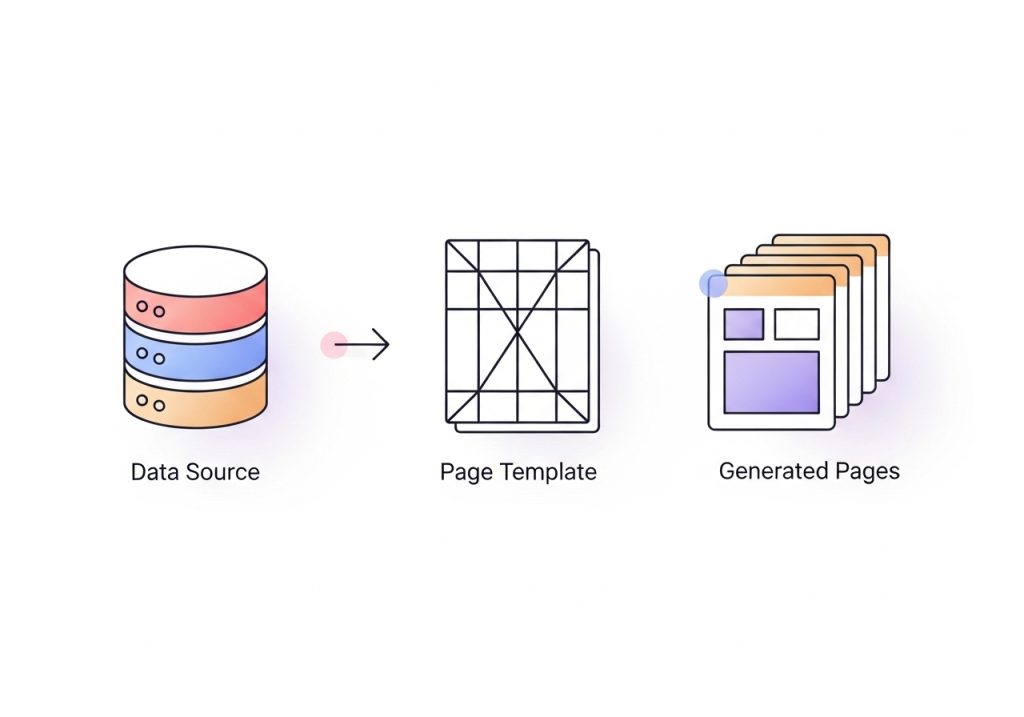
- The Data Source: This is the foundation of the entire project. The data can live in a spreadsheet, a database, or be accessed via an API. The key is that it must be structured and comprehensive. For an agency, this could be a list of services offered across different cities. For a SaaS company, it might be a database of product integrations or feature comparisons.
- The Page Template: This is the master blueprint for every page that will be generated. It’s a standard HTML layout containing static content (like headers, footers, and explanatory text) and dynamic placeholders. These placeholders are where the unique data from each row of your data source will be inserted, such as a product name, a city, or a feature description.
- The Automation Engine: This is the script or software that combines the data source and the page template. It iterates through each record in the dataset, populates the template with the corresponding information, and generates a unique HTML page for each entry. According to SEOClarity, this process is driven by structured data to generate large volumes of pages efficiently.
Real-World Examples of Programmatic SEO in Action
Many of the largest sites on the web rely on programmatic SEO to drive a significant portion of their organic traffic. These examples show how versatile the strategy can be across different industries.
- Zapier: Their app integration pages are a classic example. They have a page for every possible combination of apps you can connect, like “Connect Google Sheets to Slack.” The data source is their list of supported apps, and the template pulls in details about each app and the available automated workflows (Zaps).
- Canva: Canva uses this method for its template pages. They generate pages for keywords like “[holiday] [asset type] templates” (e.g., “Christmas Instagram post templates”). Their data source is their vast library of user-created templates, categorized by theme, style, and purpose.
- Yelp: Every time you search for “best [service] in [city],” you are landing on a programmatically generated page. Yelp’s data source is its massive database of business listings. The template is designed to display reviews, photos, operating hours, and a map for each specific business category and location.
- TripAdvisor: Similar to Yelp, TripAdvisor generates pages for attractions, hotels, and restaurants based on location. Their pages for “Things to do in [City]” are built from a database of user reviews and business data, all presented in a standardized template.
The Key Benefits for Agencies and SaaS Companies
For marketing agencies and SaaS businesses, programmatic SEO offers a powerful way to achieve significant growth that would be difficult or impossible through manual content creation alone. The primary advantages center on scale, efficiency, and market coverage.

- Massive Scalability: The most obvious benefit is the ability to grow your site’s footprint exponentially. You can go from a few dozen pages to tens of thousands without a linear increase in human effort. This allows you to compete in niches that are too broad to cover manually.
- Capture High-Intent Long-Tail Traffic: Programmatic pages are designed to answer very specific queries. Users who search for “QuickBooks integration for a construction business” have a much higher purchase intent than someone searching for “accounting software.” This targeted traffic often leads to higher conversion rates.
- Increased Operational Efficiency: Once the system is built, it frees up your marketing team from repetitive page creation tasks. This allows them to focus on higher-level activities like building a comprehensive SEO content marketing strategy, creating cornerstone content, and analyzing performance data.
- Builds Topical Authority: By creating hundreds or thousands of pages around a specific topic (e.g., software integrations, real estate listings), you send strong signals to search engines that your site is an authoritative resource in that area. This can help your entire domain rank better for related keywords.
Getting Started with Your First Programmatic Project
Launching a programmatic SEO initiative requires careful planning and a blend of marketing and technical skills. It’s a significant project, but breaking it down into manageable steps can make it more approachable.
- Identify a Valuable Dataset: The first step is to look within your business for structured data that maps to user search intent. This could be product specifications, user-generated reviews, location data, service variations, or software compatibility lists. The best datasets are unique, comprehensive, and hard for competitors to replicate.
- Conduct Keyword Research at Scale: Instead of targeting individual keywords, you need to identify patterns. Find the “head” terms (e.g., “apartments for rent”) and the “modifiers” (e.g., city names, number of bedrooms, price ranges). Your goal is to find a formula that combines these elements to create thousands of viable long-tail keywords.
- Design a High-Value Page Template: Your template must do more than just display data. It needs to provide context, add value, and create a good user experience. This includes writing unique introductory and concluding text, incorporating images or videos, and using clear and descriptive subheadings. Each generated page should feel complete and genuinely helpful to a visitor.
- Select Your Technology and Build: You need to decide how you will generate the pages. For WordPress users, certain plugins and custom post types can handle this. For more complex projects, you may need a developer to write a custom script that pulls from a database and builds static HTML files or integrates with a headless CMS.
- Launch, Monitor, and Iterate: After launching, closely monitor Google Search Console to check how many pages are being indexed. Track traffic, rankings, and user engagement metrics. Programmatic SEO is not a “set it and forget it” strategy. You may need to refine your template, improve your dataset, or build internal links to your new pages to maximize their performance.
Is Programmatic SEO the Right Strategy for You?
Programmatic SEO is a powerful strategy, but it isn’t the right fit for every business. It works best for companies that possess a large, unique, and structured dataset that directly corresponds to a high volume of specific user searches. If your business is built around aggregating information, comparing products, or serving many different locations, this approach could be a great fit.
However, it requires a significant upfront investment in planning, data preparation, and technical development. For teams without developer resources or a clear dataset, the barrier to entry can be high. The key is to evaluate whether you have the necessary data and if that data can be formatted into page templates that genuinely serve a user need. If so, a programmatic approach can become a sustainable and highly scalable engine for organic growth.
Automate Your Content, Not Just Your Pages
Scaling your content is essential for growth, but a full-scale programmatic SEO project requires significant technical resources. What if you could achieve scalable, high-quality content creation without the custom development?
Ascend automates your entire blog content strategy right from your WordPress dashboard. It handles keyword research, builds a content calendar, and publishes a unique, on-brand article every day. Grow your organic traffic and free up your team to focus on strategy, not production. Discover how Ascend makes consistent content creation effortless.

Written by
Ascend
Ascend is an automated SEO engine for WordPress. It handles keyword research, writes high-quality, search-optimized content, and publishes it directly to your site, so your traffic can grow on autopilot. Learn more