
A Practical Guide to Content Marketing for Agencies
Effective content marketing for agencies is a repeatable system for attracting ideal clients by consistently publishing expert material. Instead of relying on cold outreach or unpredictable referrals, a strong content strategy establishes your firm as an authority, drawing qualified leads directly to you. This approach creates a sustainable pipeline of new business by demonstrating your value before a prospect ever fills out a contact form. For busy agencies, the challenge is not understanding the benefits, but implementing a process that is both high-quality and efficient.
Why Content Marketing is Essential for Agency Growth
Many agencies are excellent at creating marketing campaigns for clients but often neglect their own. Content marketing is the most powerful tool an agency has for its own growth. It works by shifting the dynamic from chasing leads to attracting them. Research from professional services marketing firm Hinge shows that the fastest-growing agencies prioritize content marketing to drive profitability.
Here are the primary ways it fuels growth:
- Establishes Authority and Trust: When you consistently publish insightful articles, guides, and case studies, you prove your expertise. Prospective clients are looking for partners who understand their industry and challenges. Informative content builds that trust long before the first sales call. This is important, as studies show 92% of consumers trust earned media and recommendations, and expert content functions as a powerful form of digital word-of-mouth.
- Creates a Long-Term Asset: A paid ad stops working the moment you turn it off. A blog post can attract traffic and generate leads for years. Each piece of content you publish becomes a digital asset that works for your agency around the clock, compounding in value over time.
- Improves Organic Visibility: A well-executed content strategy is fundamental to search engine optimization (SEO). By targeting the questions your ideal clients are asking, you can rank in search results and capture high-intent traffic. This is a crucial component if you want to increase organic traffic and reduce reliance on paid channels.
- Educates and Qualifies Leads: Content acts as a silent salesperson, educating potential clients about your processes, values, and the problems you solve. When a lead comes through your content, they are already familiar with your approach and are more likely to be a good fit for your agency.
Core Pillars of a Successful Agency Content Strategy
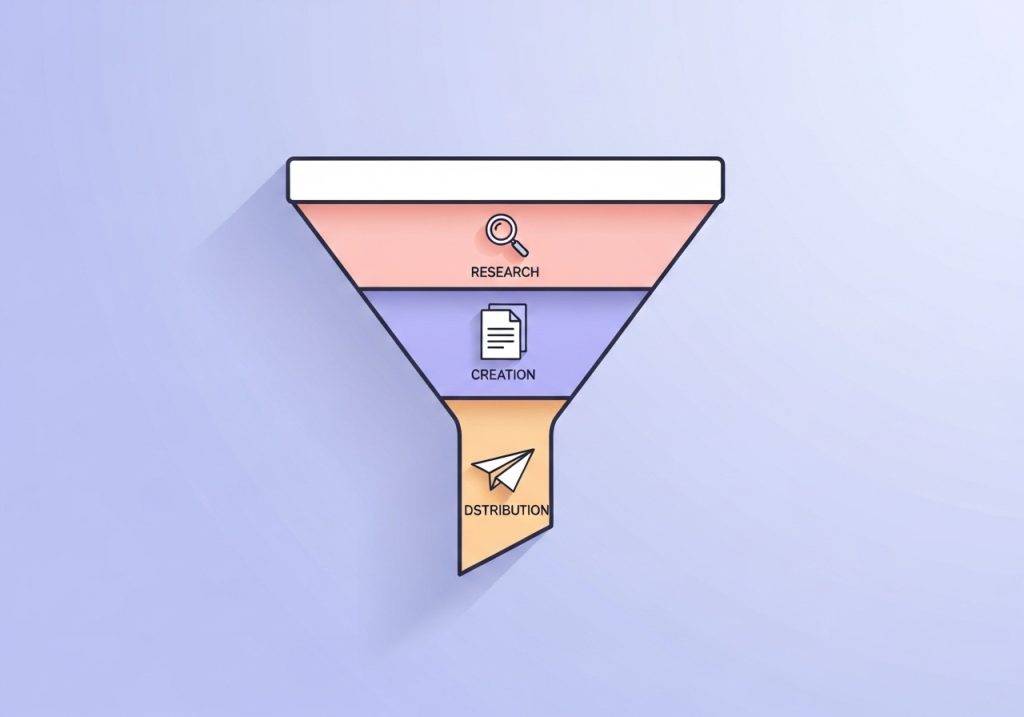
A successful content program is built on a strategic foundation, not random acts of publishing. For an agency, this means treating your own marketing with the same rigor you apply to client work. The process breaks down into a few core pillars that ensure your efforts are focused and effective.
1. Deep Audience Understanding
Before writing a single word, you must know exactly who you are trying to reach. Go beyond basic demographics. Create detailed client personas that map out their specific pain points, professional goals, and the questions they ask when searching for solutions. What keeps the CMO of a mid-sized SaaS company up at night? What are the biggest operational challenges for an influencer marketing manager? Your content should answer these questions.
2. Problem-Focused Keyword Research
Your keyword strategy should reflect your audience’s problems, not just your services. While ranking for “digital marketing agency” is difficult and attracts broad traffic, targeting more specific queries yields better results. A strategy centered on finding niche keywords that address client problems, such as “how to calculate customer acquisition cost” or “b2b lead generation tactics,” will attract prospects who are actively seeking the expertise you provide.
3. High-Value Content Creation
Your content must be genuinely useful to a discerning professional audience. Generic, surface-level articles will not position you as an expert. Focus on formats that demonstrate deep knowledge:
- In-depth Guides: Comprehensive articles that walk a reader through a complex process.
- Case Studies: Detailed stories of how you helped a client achieve specific, measurable results.
- Original Research or Data Analysis: Reports that offer unique insights into your industry.
- Expert Interviews: Conversations with other leaders in your field that provide valuable perspectives.
4. Strategic Content Distribution
Creating great content is only half the battle. You need a plan to get it in front of the right people. An effective distribution strategy includes a mix of channels, such as sharing articles on LinkedIn, sending them to your email list, and repurposing key ideas into videos or social media posts. The goal is to maximize the reach and impact of every piece you produce.
Overcoming Common Hurdles in Content Marketing for Agencies
If content marketing is so effective, why do so many agencies struggle with it? The answer lies in a set of common operational challenges that get in the way of consistency and quality. Acknowledging these hurdles is the first step toward overcoming them.
- Severe Time Constraints: The most significant barrier for any agency is time. Client work is always the top priority, which means the agency’s own marketing is often pushed to the back burner. Finding the hours to research, write, edit, and publish content consistently is a major challenge.
- Inconsistent Resource Allocation: Content marketing often falls into a gray area of responsibility. Is it the CEO’s job? A junior marketer’s? Without a dedicated person or system, efforts become sporadic. One great article might be published, followed by months of silence, which kills momentum.
- Maintaining Quality at Scale: As an agency grows, scaling content becomes harder. It can be difficult to maintain a consistent voice and level of quality when multiple people are involved or when the primary experts are too busy with billable work to write.
- Difficulty Proving ROI: The path from a person reading a blog post to signing a six-figure contract is not always a straight line. This can make it difficult to prove the direct return on investment for content, leading to a lack of buy-in from leadership.
How to Scale Agency Content Production with Automation
The solution to the agency content challenge is not simply to work harder. It is to work smarter by building a system that minimizes manual effort and maximizes output. This is where automation becomes a critical tool for scaling your content marketing. Modern AI-powered platforms can handle the most time-consuming parts of the content lifecycle, freeing your team to focus on strategy and client relationships.

Instead of struggling with a blank page, you can implement a systematic approach to automate content creation. An automated workflow can manage several key tasks:
- Keyword Research and Content Calendars: AI tools can analyze your business, competitors, and audience to perform keyword research and generate a full content calendar. This eliminates the guesswork and planning paralysis.
- First Draft Generation: Automation can produce high-quality, SEO-optimized first drafts that are already structured and researched. Your team’s role shifts from writing from scratch to editing and adding their unique expertise.
- On-Brand Image Creation: Sourcing or creating images for every post is time-consuming. AI can generate custom, on-brand visuals to accompany each article.
- Automated Publishing: A fully integrated system can handle the final steps of formatting, adding internal links, and publishing directly to your blog on a consistent schedule.
By automating the operational tasks, your agency’s experts can spend their limited time on high-value activities, like adding proprietary data, refining strategic insights, and ensuring the final piece reflects the firm’s thought leadership.
Measuring Content Success and Proving ROI
To justify the investment in content, you must track the right metrics. Success is not just about website visitors; it is about attracting the right kind of visitors and guiding them toward becoming clients. The most reputable programs, like those highlighted by the Content Marketing Institute, emphasize tracking metrics tied to business outcomes.
Focus on these key performance indicators (KPIs) to measure the true impact of your content:
- Organic Traffic and Keyword Rankings: Is your content successfully bringing in traffic from search engines? Track the growth of organic visitors and monitor your rankings for the target keywords you identified in your strategy.
- Lead Generation: How many people are taking the next step after reading your content? Measure conversions like newsletter sign-ups, downloads of gated resources (e.g., ebooks or whitepapers), and contact form submissions.
- Client Acquisition Cost (CAC): Over time, content marketing should lower your average cost to acquire a new client compared to paid advertising or other outbound methods.
- Content-Sourced Leads: Use your CRM or analytics software to track which new clients first discovered your agency through a blog post or another piece of content. This directly connects your content efforts to new revenue.
By focusing on these metrics, you can create a clear report that shows how your content marketing is not just a cost center but a powerful engine for agency growth. This data-driven approach provides the proof needed to secure ongoing investment and resources for your content program.
Running a successful content program at an agency shouldn’t require sacrificing client work or hiring a massive in-house team. Ascend automates your entire blog content strategy, from keyword research to daily publishing, right inside WordPress. Stop the content bottleneck and start growing your agency’s organic traffic. Discover how Ascend can build your content engine for you.

Written by
Ascend
Ascend is an automated SEO engine for WordPress. It handles keyword research, writes high-quality, search-optimized content, and publishes it directly to your site, so your traffic can grow on autopilot. Learn more