
Multiple Locations SEO: Architecture and Content Strategy
The Core Challenges of Multiple Locations SEO
Scaling a local business is a clear sign of success, yet it often wreaks havoc on search strategy. When a client expands from a single flagship location to five, twenty, or fifty branches, the old SEO playbook stops working. You cannot simply clone your homepage for every new city. This approach dilutes domain authority and creates massive duplicate content issues.
The primary objective of multiple locations seo is to convince search engines that your brand is the most relevant result for a user in a specific geographic area, without confusing the algorithm about your brand’s central identity. This requires a precise balance between technical architecture and creative content production.
Agencies frequently mishandle this transition. They either spin up weak landing pages that offer no value, or they create entirely separate websites for each location, fracturing their link equity. To win in local search at scale, you need a unified system that treats location pages as distinct assets rather than digital photocopies.
Before launching a hundred new pages, it is critical to perform marketing competitive analysis using data to see how established rivals in those specific regions structure their hierarchy. If the top-ranking competitor in Chicago uses a flat URL structure while the winner in Miami uses deep sub-folders, that data should inform your strategy.
Structuring Your Site Architecture
The foundation of multi-location visibility is URL structure. This is a binary choice with significant consequences: subdomains versus subdirectories. While subdomains (e.g., austin.brand.com) might seem easier for developers to manage initially, they are generally the wrong choice for SEO.
Search engines often treat subdomains as separate entities. If you split your brand across fifty subdomains, you split your authority fifty ways. A link earned by your Austin page does little to help your Boston page rank.
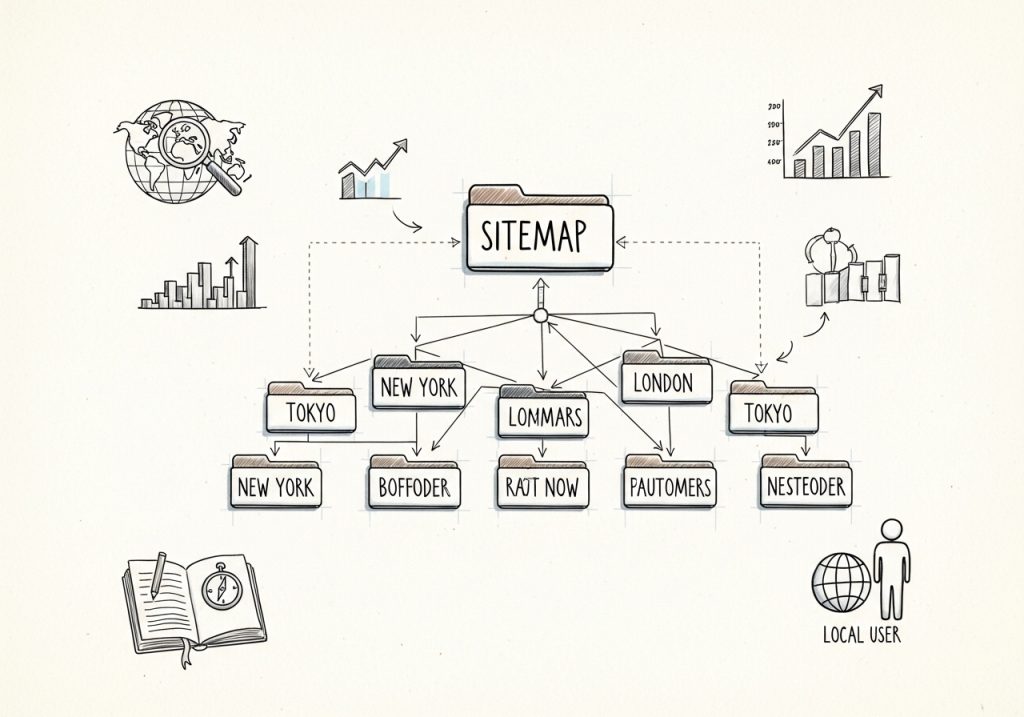
The superior approach is almost always subdirectories (e.g., brand.com/locations/austin). This consolidates link equity on the root domain. Every backlink your location pages earn strengthens the entire site, and the authority of your homepage trickles down to help new location pages rank faster.
A clean folder structure also simplifies tracking. It allows for easier segmentation when executing a framework for organic growth site analysis, as you can filter traffic by the /locations/ path to isolate local performance from general blog or product traffic. Keep your URLs clean, descriptive, and consistent. Avoid using obscure parameter IDs like /store-id=402 when /locations/denver-downtown provides both user clarity and keyword relevance.
Google Business Profile Optimization at Scale
Your on-site architecture must pair with an off-site map strategy. The Google Business Profile (formerly GMB) is the source of truth for local packs. Managing one profile is simple; managing a franchise network requires strict protocols.
Consistency is the priority. Your Name, Address, and Phone number (NAP) must match exactly across your website and your Google profiles. A common error is inconsistent naming conventions. One manager might name a branch “Acme Co. – Downtown” while another names theirs “Acme Company Westside.” This inconsistency confuses data aggregators.
Establish a master spreadsheet or use a management platform to control these details. Ensure every location has a unique phone number and a direct URL linking to its specific location landing page, not the homepage. This direct link reinforces the connection between the specific geographic page on your site and the map listing.
Scaling Unique Content for Location Pages
The most resource-intensive part of multiple locations seo is writing the copy. You cannot copy and paste the same service descriptions across fifty pages and expect Google to rank all of them. While a “duplicate content penalty” is often misunderstood—Google usually just filters out duplicates rather than banning the site—the result is the same: your pages won’t rank.

Each page needs unique value. This is difficult when the services offered are identical in every city. To solve this, focus on what is different: the environment, the team, and the local customer needs.
- Local Specifics: Mention specific landmarks, neighborhoods, or intersections near the business. This signals genuine local relevance.
- Team Bios: Feature the manager or staff specific to that branch.
- Local Reviews: Embed reviews specifically for that location, not generic company-wide testimonials.
- Regional FAQs: Address questions specific to that area. Parking situations, local regulations, or regional climate issues that affect the service (e.g., HVAC needs in Phoenix differ from Minneapolis).
Producing this volume of content is expensive. For agencies, restructuring how you sell content services is essential to maintain profitability while delivering this level of granularity. You need a process that creates high-quality, non-duplicative drafts efficiently, ensuring that every new location page has at least 500 words of unique, helpful text.
Implementing Local Schema Markup
Structured data helps search engines understand the context of your content. For multi-location brands, LocalBusiness schema is mandatory. This code runs in the background and explicitly tells Google the address, hours, and geo-coordinates of the business represented on that specific page.
Do not apply a site-wide schema that points to your headquarters on every page. Each location landing page must have its own specific JSON-LD script containing the unique details of that branch. Use the “hasMap” property to link to the Google Maps entry, and ensuring the “geo” property (latitude and longitude) is precise.
This technical implementation reduces ambiguity. It confirms to the search engine that the page isn’t just about Dallas—it represents a physical entity in Dallas.
Execution is the Differentiator
Ranking in multiple cities is rarely a mystery; it is a logistics challenge. The winners in local search are not always the brands with the biggest budgets, but the ones with the most disciplined architecture and content workflows. By consolidating your authority through subdirectories, enforcing data consistency, and investing in unique content for every branch, you build a digital footprint that dominates local packs across every territory you enter.
Ready to scale your local content without the burnout? Ascend automates high-quality, SEO-optimized blog posts for every location and niche you manage. Start building your organic traffic engine today at Ascend Blog.

Written by
Ascend
Ascend is an automated SEO engine for WordPress. It handles keyword research, writes high-quality, search-optimized content, and publishes it directly to your site, so your traffic can grow on autopilot. Learn more