
Selling Content Services: How Agencies Scale Profitability
Most digital agencies hit a revenue ceiling that feels impossible to break. You sign a new client, but the workload increases in direct proportion to the revenue. You hire more writers, add more editors, and suddenly your margins vanish into overhead. This is the fundamental trap of selling content services using traditional models. The agency trades time for money, and eventually, you run out of time.
Scaling a content agency requires a fundamental shift in how you package, produce, and price your work. The goal is to decouple the hours spent writing from the value delivered to the client. By restructuring your offers and integrating intelligent automation, you can turn a low-margin service into a high-profit growth engine.
The Economics of Selling Content Services
The standard agency pricing model for content often relies on per-word or per-hour rates. This creates a perverse incentive structure. If you charge by the word, you are financially motivated to be verbose rather than concise. If you charge by the hour, efficiency actually reduces your revenue.
Clients do not care how many hours you spent researching a topic or how many words are on the page. They care about the outcome: organic traffic, domain authority, and leads. When you price based on inputs (words/hours) rather than outputs (assets/results), you commoditize your service. You place your agency in direct competition with freelance marketplaces where the lowest price wins.
To fix this, you must stop selling the writing process and start selling the completed asset. A flat fee for a “high-authority blog post” protects your margins. It allows you to optimize your internal production costs without lowering the price the client pays. The difference between your production cost and the flat fee becomes your profit margin, which you can expand through efficiency.
Moving Beyond the Word Count
Shifting the conversation away from volume is difficult but necessary. Clients are conditioned to ask, “How long will this article be?” You need to retrain them to ask, “What problem does this article solve?”
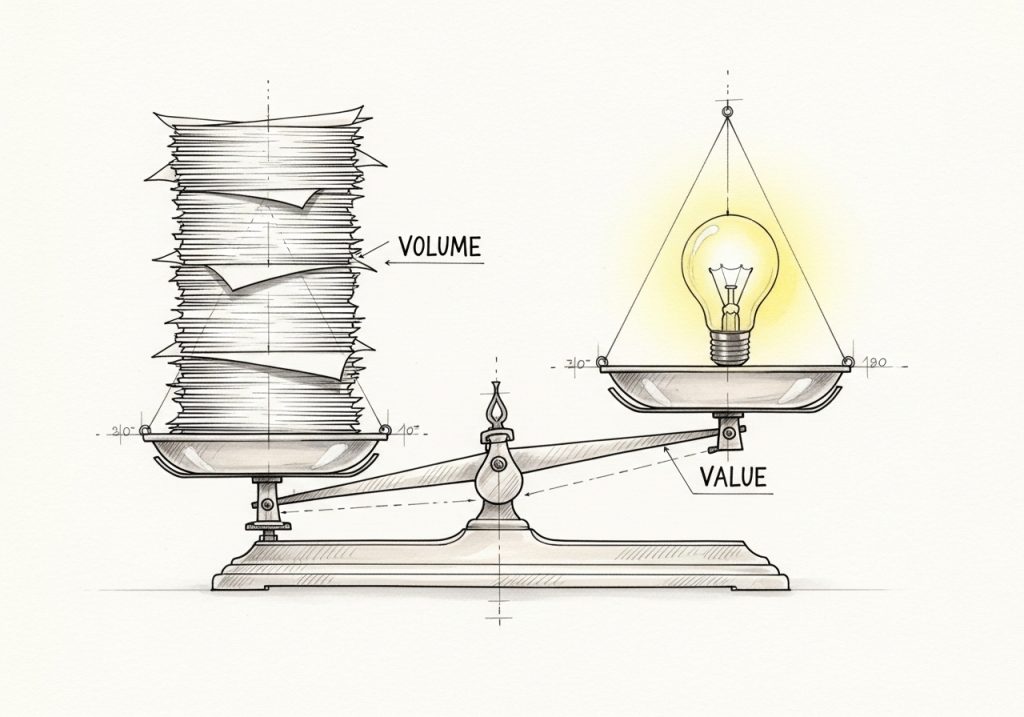
Value-based selling focuses on the strategic intent of the content. Is this piece designed to rank for a high-intent keyword? Is it a link-magnet asset? The value lies in the strategy and the technical execution, not the length. As search engines evolve, the metrics for success are changing. It is no longer just about keywords; it is about answering user intent comprehensively.
Agencies that understand What Is Generative Engine Optimization (GEO)? The Next Evolution of Search can charge a premium. You are not just writing text; you are optimizing for the new wave of AI-driven search experiences. By positioning your service as a technical growth lever rather than simple copywriting, you separate yourself from the commodity market.
The Role of Automation in Selling Content
Once you establish a flat-fee or value-based pricing model, your internal goal is to reduce production time while maintaining quality. This is where automation becomes the primary driver of profitability.
Historically, an agency might spend four hours researching, outlining, and drafting a single post. With tools like Ascend, that timeline compresses to minutes. Automation handles the heavy lifting of keyword research, competitor analysis, and initial drafting. This allows your team to function as editors and strategists rather than just writers.

The danger for many agencies is seeing automation as a way to fire staff. The smarter play is to increase volume. Instead of delivering four posts a month, you can now deliver thirty. This volume allows you to dominate a client’s niche faster. It moves the client past the initial setup phase—where their blog is just a default Hello world! placeholder—and into a robust resource library in weeks instead of years.
Selling content supported by automation means you are selling consistency. You promise the client that their blog will never go dormant. This reliability is a massive selling point for marketing directors who struggle to keep their content calendars full.
Structuring Your Offer for Recurring Revenue
Project-based work creates cash flow volatility. The most profitable agencies sell retainers. However, a retainer for “4 blog posts a month” is often the first thing cut when a client’s budget gets tight. To make your retainer sticky, you must bundle content production with distribution and reporting.
Your offer should look like a complete growth product:
- Core Content: Daily or weekly posts generated and polished by your team.
- Technical Optimization: Native SEO integration (handled automatically by tools like Ascend).
- Performance Reporting: Monthly data showing growth.
Reporting is the bridge between your work and the client’s wallet. If you cannot prove that your content is driving results, you will lose the contract. You need to be Mastering SEO Reports for Clients: A Guide to Proving Value. When a client sees a clear line between the content you sold them and the upward trend in their analytics, the retainer becomes an investment, not an expense.
Maintaining Quality at Scale
The hesitation to scale often comes from a fear of quality degradation. If you increase output by 10x, does the quality drop? It does if you lack a system. But if you have the right infrastructure, quality can actually improve.
Automation ensures that no technical SEO step is missed. It ensures that internal linking is consistent. It ensures that every post targets a specific keyword. Your human team then provides the final layer of polish—checking for tone, brand alignment, and factual accuracy.
This “human-in-the-loop” approach is the standard for modern agencies. You use AI to build the structure and fill the walls; you use humans to decorate the room. This division of labor allows a small team to manage a massive portfolio of clients without burnout.
Scaling profitability isn’t about working harder. It is about building a machine that produces value efficiently. By moving away from hourly billing, leveraging automation for volume, and focusing on strategic reporting, you transform your agency from a service provider into a growth partner.
Stop spending hours on keyword research and drafting. Ascend automates your entire blog content workflow, helping you deliver high-quality, SEO-optimized posts every single day. Scale your agency’s output without scaling your overhead.

Written by
Ascend
Ascend is an automated SEO engine for WordPress. It handles keyword research, writes high-quality, search-optimized content, and publishes it directly to your site, so your traffic can grow on autopilot. Learn more