
What Is Content Automation Marketing and How Does It Work?
Content automation marketing is the use of artificial intelligence and software to streamline the entire content lifecycle, from initial keyword research and topic planning to writing, publishing, and performance analysis. This approach allows marketing teams at agencies and SaaS companies to scale their content production efficiently, maintain a consistent publishing schedule, and focus their resources on high-level strategy rather than manual execution. By handling the repetitive tasks involved in content creation, automation platforms help businesses grow their organic traffic without a proportional increase in headcount or workload.
Defining Content Automation in a Marketing Context
Content automation goes beyond simply generating text. It represents a systematic approach to managing the complete workflow of content marketing. Think of it as an operational framework powered by technology. According to industry analysis, content automation is the use of AI and software to manage planning, creation, publishing, and tracking. This means that instead of a marketer manually performing each step, a specialized tool handles the bulk of the process.
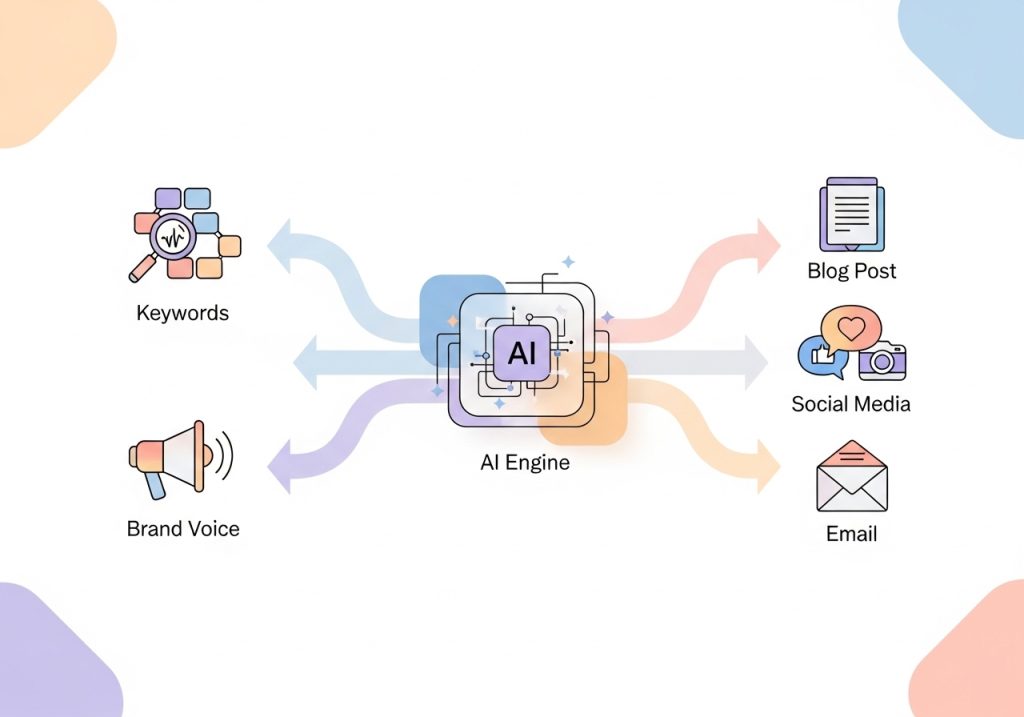
The system typically starts by analyzing inputs like target audience profiles, brand voice guidelines, and strategic keywords. From there, it can generate a content calendar, write draft articles, find relevant images, and even schedule the final posts within a content management system like WordPress. The goal is not to remove humans from the process entirely but to augment their capabilities, allowing them to act as editors and strategists who guide the automated system.
The Core Benefits of Automated Content for Agencies and SaaS
For fast-moving organizations like marketing agencies and software companies, the advantages of integrating content automation are significant. The pressure to produce high-quality content consistently is immense, and automation provides a direct solution to common bottlenecks.
- Increased Efficiency: The most immediate benefit is the reduction in time spent on content production. Tasks that once took hours, such as keyword research, outlining, and drafting, can be completed in minutes. This frees up marketing teams to concentrate on promotion, client relationships, and campaign analysis.
- Consistent Publishing Volume: Search engines reward websites that publish fresh, relevant content regularly. Automation ensures a steady cadence of blog posts, which helps build topical authority and improve search rankings over time. This consistency can be difficult to maintain with manual processes alone.
- Scalable Growth: Automation makes it possible to scale content efforts without scaling the team. An agency can manage content for ten clients with the same resources it once used for three. For SaaS companies, it enables the creation of vast libraries of help articles and tutorials, which improves customer support and captures long-tail search traffic. Effective automation makes the core strategies of content marketing for businesses with limited resources much more attainable.
- Improved Data Integration: Many automation platforms integrate directly with analytics tools. This allows for a continuous feedback loop where performance data informs future content strategy. The system can identify which topics resonate most with the audience and double down on what works.
How Content Automation Marketing Platforms Operate
While different platforms have unique features, the underlying process of content automation marketing follows a logical sequence. It transforms strategic goals into published assets through a series of automated steps. The process shows how AI content creation works in a structured, repeatable way.
The typical workflow includes:
- Strategy and Input: The user provides the system with foundational information. This includes the company’s domain, target keywords, competitor websites, and detailed brand voice guidelines. The more precise the input, the more on-brand the output will be.
- Automated Research and Planning: The AI analyzes top-ranking content for the target keywords to understand search intent and identify important subtopics. It then generates a content calendar with optimized titles and outlines for the upcoming month.
- Content Generation: Using the approved plan, the system writes full-length articles. Advanced platforms can incorporate internal linking, format text with headings and lists, and source or create relevant images.
- Review and Publishing: The generated content is delivered as a draft for human review. A marketer can then make edits, approve the post, and schedule it for publication directly from their dashboard. The best tools integrate natively with platforms like WordPress, making the final step seamless.
Practical Applications: Scaling SEO and Audience Engagement
Content automation is particularly effective for executing specific marketing strategies that depend on scale and consistency. Agencies and SaaS businesses can apply it to achieve several key objectives.
One primary application is for high-volume SEO blogging. By publishing content daily or several times a week, a company can target hundreds of long-tail keywords. This builds a strong foundation of organic traffic and establishes the website as an authority in its niche. Another powerful use is to support strategies like programmatic SEO, where thousands of pages are created based on a data set. Automation can generate the unique content needed for each page, making such a large-scale project feasible.
For marketing agencies, automation is a powerful tool for client management. It allows them to deliver consistent results across their entire client portfolio without needing a massive team of writers. They can set up automated workflows for each client, ensuring that content calendars are always full and deadlines are always met.
Implementing an Automated Content Strategy
Successfully adopting content automation requires more than just subscribing to a tool. It requires a thoughtful implementation plan to ensure the technology aligns with your business goals. Start by defining clear objectives. Do you want to increase organic traffic by a certain percentage, generate more leads, or reduce content production costs? Your goals will determine how you configure and use the automation platform.
Next, develop comprehensive brand guidelines for the AI to follow. This should include details about your tone of voice, preferred terminology, formatting rules, and examples of existing content you like. A well-defined guideline is critical for generating content that feels authentic to your brand. Finally, establish a human-in-the-loop workflow. While the AI does the heavy lifting, a human editor should always review and approve content before it goes live. This ensures quality, accuracy, and strategic alignment.
Measuring the ROI of Your Automated Content Efforts
To justify the investment in content automation, it is important to track its return on investment (ROI). Success can be measured through a combination of performance metrics and operational savings. As recent research from Deloitte Digital highlights, evolved content strategies are driving measurable results for leading marketing organizations, and automation is a key part of that evolution.
Key performance indicators (KPIs) to monitor include:
- Organic Traffic Growth: The primary goal for most content marketing is to attract more visitors from search engines. Use tools like Google Analytics to track this over time.
- Keyword Rankings: Monitor your position in search results for your target keywords using a tool like Google Search Console or Ahrefs.
- Conversion Rates: Track how many visitors from your automated content complete a desired action, such as signing up for a newsletter or requesting a demo.
- Time and Cost Savings: Calculate the number of hours your team saves each month on content creation. If you were previously using freelancers, compare the cost of the automation tool to your past invoices.

By tracking these metrics, you can build a clear picture of how content automation is contributing to your business’s bottom line. The combination of increased traffic, better efficiency, and lower costs presents a compelling case for its adoption.
Ultimately, content automation marketing is a strategic asset for any modern marketing team. It transforms content creation from a time-consuming manual chore into a scalable, efficient system. By letting technology handle the repetitive work, you empower your team to focus on what humans do best: building strategy, fostering creativity, and connecting with customers. The key is to choose the right platform and implement it as a core part of your marketing operations.
Ready to put your blog on autopilot and reclaim your time? Ascend is a fully automated AI content creation tool for WordPress. It handles everything from keyword research to writing and publishing, all from your dashboard. Learn how Ascend can help you scale your organic traffic today.

Written by
Ascend
Ascend is an automated SEO engine for WordPress. It handles keyword research, writes high-quality, search-optimized content, and publishes it directly to your site, so your traffic can grow on autopilot. Learn more