
What Is AI-Powered Content Generation and How Does It Work?
AI-powered content generation is the use of artificial intelligence and machine learning models to automatically create new written text, images, or other digital media. For marketing agencies and SaaS companies, this technology provides a way to scale content production, maintain a consistent publishing schedule, and drive organic traffic without a proportional increase in manual effort. It transforms the time-intensive process of content creation into a more efficient, automated workflow.
Understanding AI-Powered Content Generation
At its core, ai-powered content generation uses complex algorithms, often called large language models (LLMs), that have been trained on vast amounts of data from the internet. These models learn the patterns, structures, and nuances of human language and visual styles. When given a prompt or a set of instructions, the AI can produce original content that aligns with the user’s request. According to Roots Analysis, this involves using AI to “generate, optimize, and manage various forms of digital content.”
This isn’t limited to just writing blog posts. The technology can produce a wide range of materials, including:
- Long-form articles: SEO-optimized blog posts, white papers, and guides.
- Short-form copy: Social media updates, ad headlines, and product descriptions.
- Visuals: Custom images, illustrations, and infographics.
- Technical content: Code snippets, documentation, and reports.
The main goal is to augment human capabilities. By handling the initial research, drafting, and idea generation, these systems allow marketing teams to focus on strategy, editing, and creative direction. This shifts the role of a content creator from a writer to a manager of an automated content engine.
The Strategic Advantage for Marketing Agencies
For marketing agencies, creator platforms, and SaaS businesses, the pressure to produce high-quality content consistently is immense. AI-powered content generation offers a significant strategic advantage by addressing common bottlenecks in the content workflow. The benefits directly impact efficiency, client capacity, and profitability.
Key advantages include:
- Increased Efficiency: The most immediate benefit is a dramatic reduction in the time it takes to produce a piece of content. What once took hours of research, outlining, and writing can now be drafted in minutes. This acceleration allows teams to meet tight deadlines and respond quickly to market trends.
- Enhanced Scalability: Scaling a content team traditionally requires hiring more writers, editors, and strategists. AI tools allow an agency to increase its content output without a linear increase in headcount. This makes it possible to serve more clients or expand a brand’s digital footprint more rapidly. By implementing a system to automate blog posting, teams can build a reliable content pipeline.
- Improved Consistency: Maintaining a consistent publishing schedule is vital for building an audience and improving SEO rankings. Automation ensures that content is created and published on a regular basis, helping to build momentum and keep your brand top-of-mind.
- Cost Reduction: By automating many of the manual tasks involved in content creation, businesses can lower their cost per article. This allows for a higher return on investment from content marketing efforts and makes it possible to execute more ambitious strategies on a limited budget.
How AI Models Create Human-Like Content
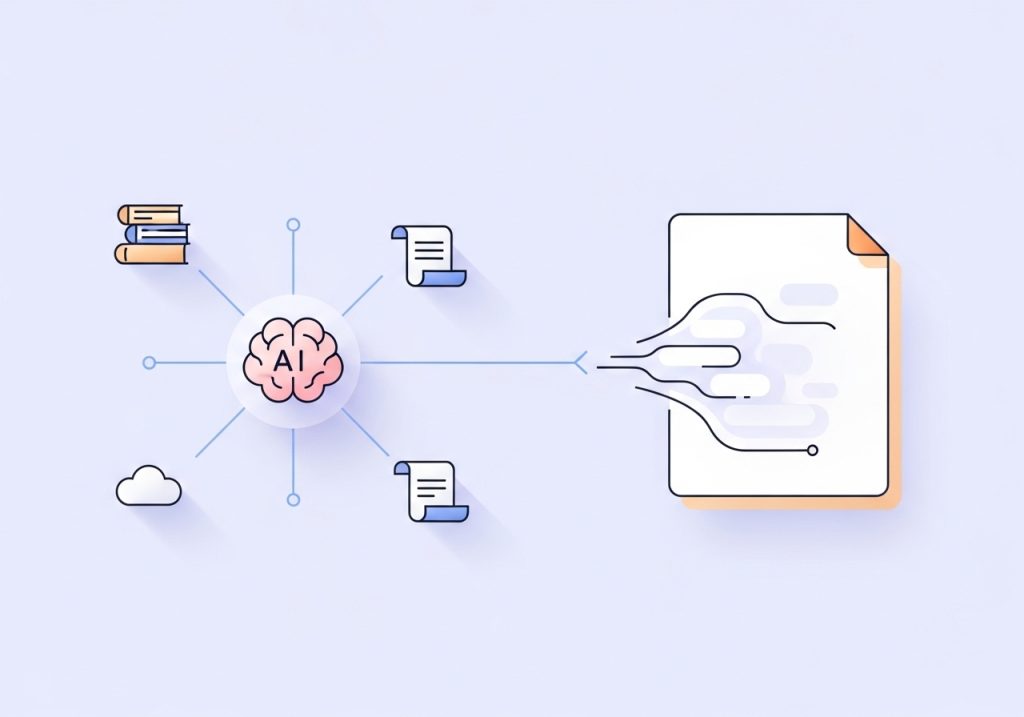
The technology behind AI content generation may seem complex, but its underlying principles are straightforward. The process relies on a field of AI called Natural Language Processing (NLP) and the massive neural networks known as Large Language Models (LLMs). An LLM is trained on terabytes of text and code, allowing it to understand context, grammar, and style.
Think of an LLM as a highly advanced prediction engine. When you provide it with a prompt, such as “Write a paragraph about the benefits of SEO,” it doesn’t “think” in the human sense. Instead, it calculates the most probable sequence of words to follow your input based on the patterns it learned during its training. This process of automatic writing allows the model to construct coherent sentences, paragraphs, and even entire articles that are often indistinguishable from human-written text.
For images, a similar process occurs with what are known as diffusion models. These models are trained on millions of image-text pairs. When you provide a text description, the AI generates an image that matches that description by starting with random noise and gradually refining it into a coherent picture. The sophistication of these models continues to grow, enabling the creation of highly specific and high-quality visuals on demand.
Practical Applications in Modern Marketing Workflows
The theoretical benefits of AI content generation become tangible when applied to daily marketing tasks. Agencies and SaaS companies are integrating these tools to streamline workflows and produce more effective campaigns. The AI-powered content creation market was valued at $2.2 billion in 2024 and is projected to reach $10.6 billion by 2033, according to Grand View Research, which shows its rapid adoption.
Here are some practical applications:
- SEO Content at Scale: One of the most powerful uses is generating first drafts of SEO-driven blog posts. By providing a target keyword and a brief outline, a tool can produce a well-structured article that covers the key talking points, which a human editor can then refine and fact-check.
- Social Media Management: An AI can create dozens of variations of a social media post for different platforms and audiences. This helps keep social channels active with fresh content and allows for extensive A/B testing to see which messages resonate most.
- Advertising and PPC Campaigns: Writing compelling ad copy is challenging. AI can generate numerous headlines and descriptions for Google Ads or social media ads, helping marketers quickly test different angles to optimize click-through rates and conversions.
- Email Marketing Campaigns: From drafting weekly newsletters to writing multi-part drip campaigns, AI can handle the bulk of the writing. This frees up marketers to focus on segmentation, personalization strategy, and performance analysis.

Integrating Automated Content Into Your Strategy
Successfully adopting AI-powered content generation requires more than just subscribing to a tool. It requires a thoughtful integration into your existing content strategy. The goal is not to replace human marketers but to empower them with a more powerful toolkit. There are several AI content creation tools available, and choosing the right one depends on your specific needs.
Follow these steps for a smooth integration:
- Set Clear Objectives: Begin by identifying what you want to achieve. Are you trying to increase your publishing frequency from one to five posts per week? Do you need to produce more social media content? Having specific goals will help you measure the impact of automation.
- Develop AI-Ready Brand Guidelines: For an AI to produce on-brand content, it needs clear instructions. Create a detailed style guide that covers your brand’s tone of voice, preferred terminology, formatting rules, and target audience. Advanced platforms can learn these guidelines to ensure consistency.
- Maintain Human Oversight: AI-generated content should always be considered a first draft. A human editor must review every piece for accuracy, originality, and alignment with brand strategy. This “human-in-the-loop” approach ensures quality while still benefiting from the speed of automation.
- Focus on Value and Originality: Use AI to handle the foundational work, then have your team add unique insights, expert opinions, and real-world examples. This combination of AI efficiency and human expertise produces content that is both scalable and valuable to your audience.
- Measure and Refine: Track the performance of your AI-assisted content. Monitor metrics like organic traffic, keyword rankings, engagement rates, and conversions. Use this data to refine your prompts, adjust your strategy, and improve the quality of your output over time.
AI-powered content generation is a powerful asset for any modern marketing team. When implemented thoughtfully, it streamlines workflows, enhances scalability, and allows your team to focus on the strategic work that drives real business growth. The key is to view it not as a replacement for human creativity but as a collaborator that handles the heavy lifting.
Ready to put your content strategy on autopilot? Ascend fully automates your WordPress blog, from keyword research and content calendars to writing and publishing daily, SEO-optimized articles. Free up your team to focus on strategy while Ascend handles the entire content lifecycle, right from your dashboard. Discover how Ascend can scale your organic traffic.

Written by
Ascend
Ascend is an automated SEO engine for WordPress. It handles keyword research, writes high-quality, search-optimized content, and publishes it directly to your site, so your traffic can grow on autopilot. Learn more